
Sample approval guide · Reviewed 24 August 2026
A sewn-product sample can look finished without answering the questions needed for approval. Clean stitching, a good shape and materials that resemble an approved swatch do not confirm that a bag, case or organizer works when loaded, carried, mounted or operated. Sample review should decide whether the available evidence supports a defined next stage—and record what remains open.
Sample-stage names vary. A prototype may test rough geometry or describe a more complete development sample. A “pre-production sample” should not be treated as production-representative until its materials, components, construction, artwork and substitutions are confirmed. Start with documented purpose, not the label.
This guide provides a review framework for functional bags and equipment cases, vehicle organizers and mobility soft accessories, and other structured sewn products. Project-specific specifications, validation and release decisions still apply.
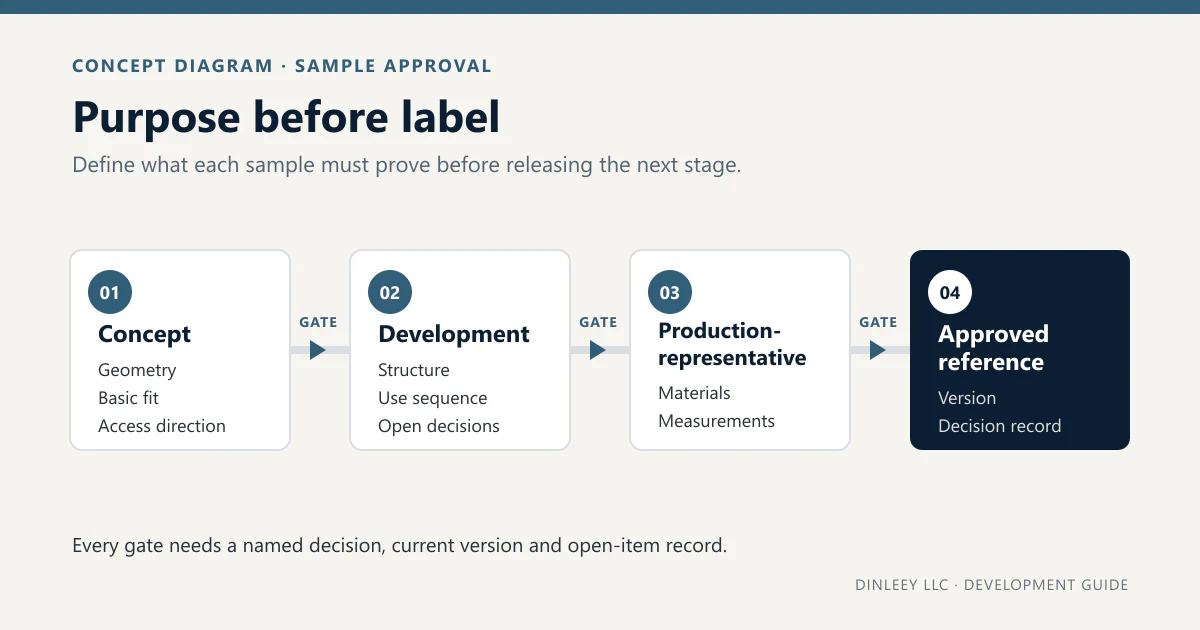
1. Define What the Sample Must Prove
Before evaluating the physical product, write down the decision the sample is meant to support. A review can only be consistent when the team agrees on the gate.
| Sample purpose | Typical questions | Evidence needed before the next stage |
|---|---|---|
| Concept and geometry | Are size, shape and arrangement workable? | Dimensions, rough fit, access and structural direction |
| Material or component trial | Does one material, component or process suit the use? | Approved reference, substitution status and needed evidence |
| Production-representative review | Does the build reflect the current specification? | Confirmed construction, materials, critical measurements, artwork and open items |
| Approved physical reference | Which exact version becomes the comparison standard? | Approval authority, dated version, linked specification and decision record |
For every sample round:
- Record the project or style identifier, sample round, date and specification revision.
- Separate fixed requirements, temporary substitutions and intentionally open decisions.
- Identify who consolidates comments and who has approval authority.
- State what the decision will release: another prototype, testing, costing, pilot production, packaging work or another defined stage.
The approved sample needs a version and documentation link so development, sourcing and production refer to the same baseline.
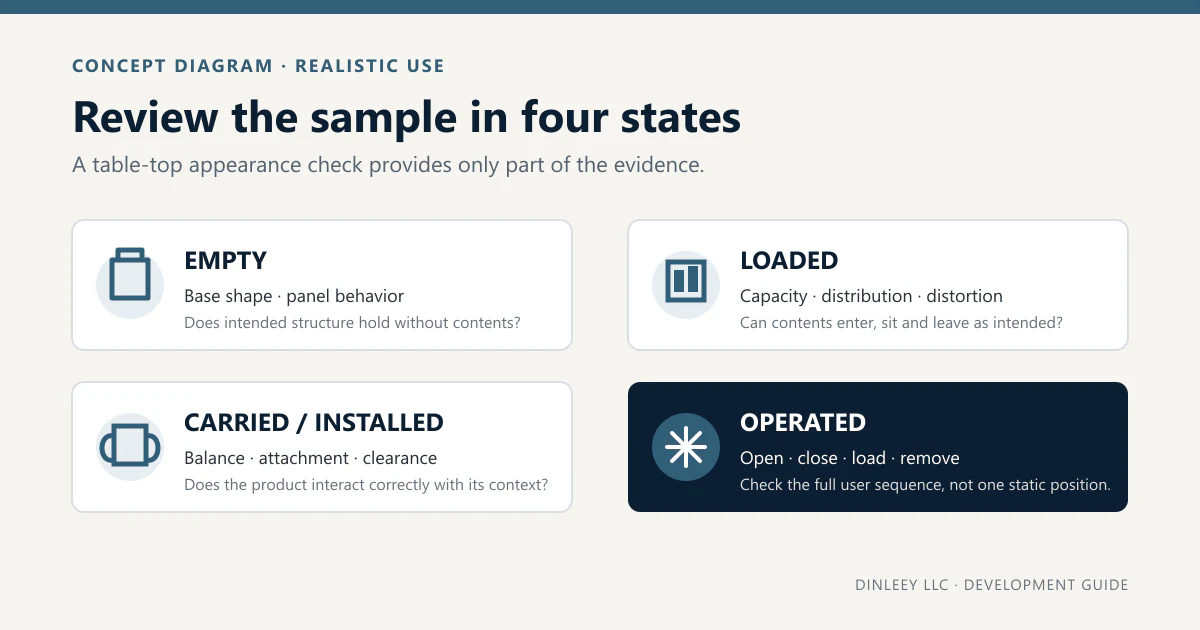
2. Review the Product in Realistic Use States
A table-top review provides only part of the evidence. Examine the sample in the states relevant to its intended use:
| Review state | What to observe |
|---|---|
| Empty | Base shape, panel behavior, fold lines and structure that should hold form without contents |
| Loaded | Capacity, load distribution, opening clearance, panel distortion and pressure at seams or anchors |
| Carried or installed | Balance, stability, attachment engagement, clearance and interaction with the surrounding environment |
| Operated | Full opening, closing, loading, unloading, removal and reinstallation sequence |
For vehicle organizers, review in the intended installation environment when available. Check attachment points, access, trim clearance and interaction with relevant seat, door, tailgate or cargo-area movement. Claim fit for a make, model or model year only when that application has documented, product-specific verification.
For bags and cases, load the intended contents or dimensionally representative substitutes. Check usability, stability, opening access and whether the load sits where the structure was designed to carry it.
3. Check Fit, Capacity, Access and User Sequence
Outside dimensions do not prove usable capacity. A pocket can match a drawing and still be difficult to load because the opening is obstructed, the zipper travel is too short or another compartment occupies the same space when full.
Review the actual sequence:
- Can the largest intended item clear the opening?
- Can contents be seen, reached and removed in the intended orientation?
- Does the opening remain usable when nearby compartments are loaded?
- Do zipper paths, flaps, buckles or handles interfere with one another?
- Are one-hand, gloved-hand or limited-mobility requirements relevant to this use case?
- For an installed organizer, can the user reach the contents without disturbing the attachment system?
- For a carry product, does the load remain positioned as intended through lifting, carrying and setting down?
Record the step where a failure occurs. “Pocket too small” is less useful than “the intended item fits inside but cannot clear the opening when the adjacent compartment is loaded.”
When requirements are still open, the custom product development process should begin with the use case, contents, installation or carrying context and approval criteria.
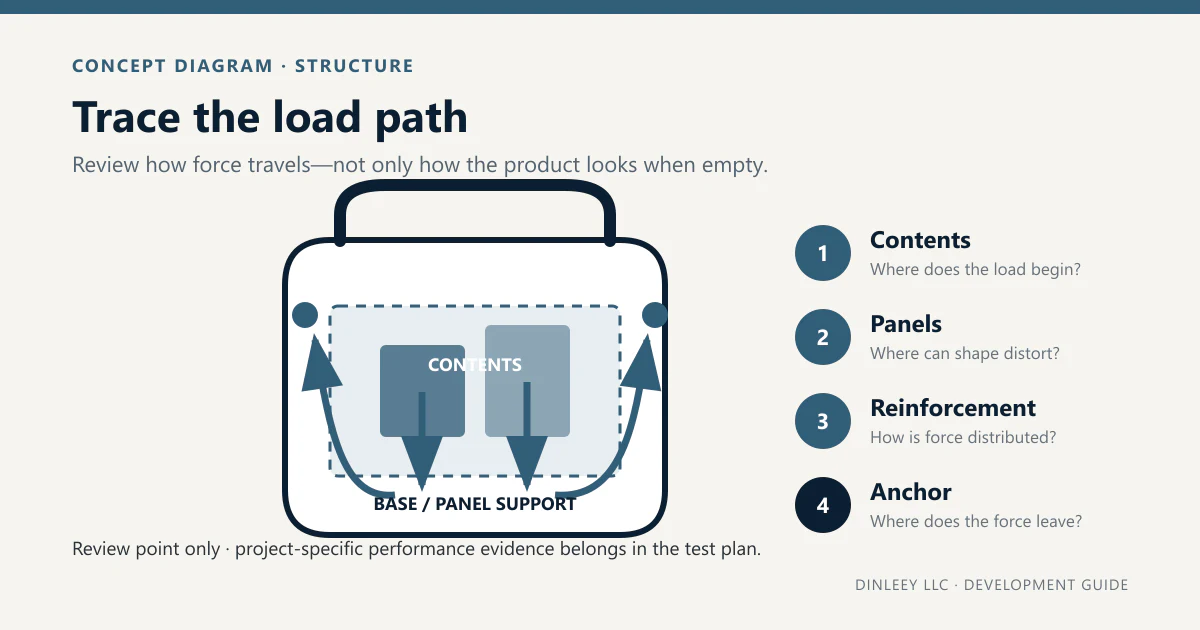
4. Trace Structure and Load Paths
Review structure as a system. Foam, board, reinforcement, binding and stitching may affect shape, but the appropriate combination depends on geometry, load, exposure and use.
Check:
- Panel support and the position of foam, board or other reinforcement.
- Base behavior and whether the product sags, twists or loses its intended shape when loaded.
- Fold lines, dividers and partitions after contents are inserted.
- Handle, strap and anchor reinforcement.
- How force travels from the loaded area through attachment points into the body of the product.
- Edge pressure, seam distortion and local concentration around hardware or anchors within the defined review conditions.
Do not infer durability from one short handling check. Physical review can reveal load-path problems; project-specific performance evidence belongs in the test plan.
5. Confirm Materials, Components and Substitutions
Compare the sample with the current approved references for:
- Face material and lining.
- Foam, board or reinforcement.
- Webbing.
- Zipper tape or chain, slider and pull tab.
- Buckles, hooks and other hardware.
- Thread.
- Labels, artwork and branding placement.
Mark every substitution. A temporary zipper color, unavailable buckle or alternative foam may answer one development question without being accepted for production. Color, hand feel, odor, cleaning behavior, performance and supply availability remain open until the intended component and required evidence are reviewed.
For a fuller selection framework, see How to Specify Materials for Structured Sewn Products.
6. Measure Critical Features and Separate Function from Appearance
Define a measurement method for each critical feature. Depending on the product, one overall tolerance range may not be enough for an opening width, anchor spacing or divider position that controls function.
Review:
- Critical dimensions and how each is measured.
- Symmetry and panel alignment.
- Seam, binding and stitch control.
- Corner and edge finish.
- Zipper and hardware operation under the defined use cycle for this review.
- Component, artwork and label placement.
- Visible cleanliness and finish.
Separate observations into useful priority levels:
- Functional or release-blocking: changes fit, access, structure, safety direction, use sequence or a confirmed requirement.
- Production or manufacturability: affects repeatability, assembly method, material use or process control.
- Cosmetic: affects appearance but does not change the intended function.
- Information required: cannot be closed until a drawing, material reference, test result or approval owner supplies missing evidence.
This keeps a minor finish note separate from an issue that makes the product unusable.
7. Identify Evidence That the Sample Cannot Provide
Sample review, performance validation and production-lot sampling answer different questions:
- Sample review: Does this physical version meet the defined development and approval criteria?
- Performance validation: Does the design or material meet project-specific use, load, durability, environmental or other requirements under an agreed method?
- Production-lot acceptance: Does a manufactured lot meet an agreed quality plan and sampling rule?
Do not treat them as interchangeable. One prototype cannot establish future lot consistency, and an inspection plan cannot correct unresolved design.
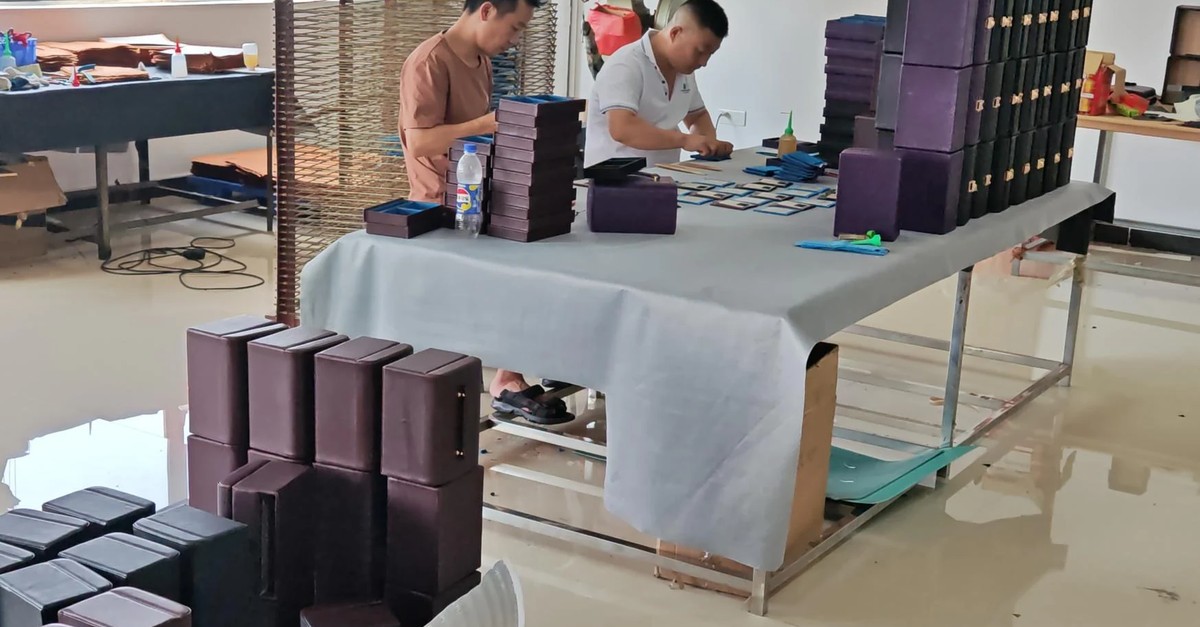
DINLEEY’s guide to building a product test plan explains how to connect requirements, methods, acceptance criteria and records. AQL Is Not a Quality System explains the separate role of acceptance sampling. DINLEEY’s quality and project-management approach provides the broader development context.
8. Write Revision Feedback That Can Be Executed
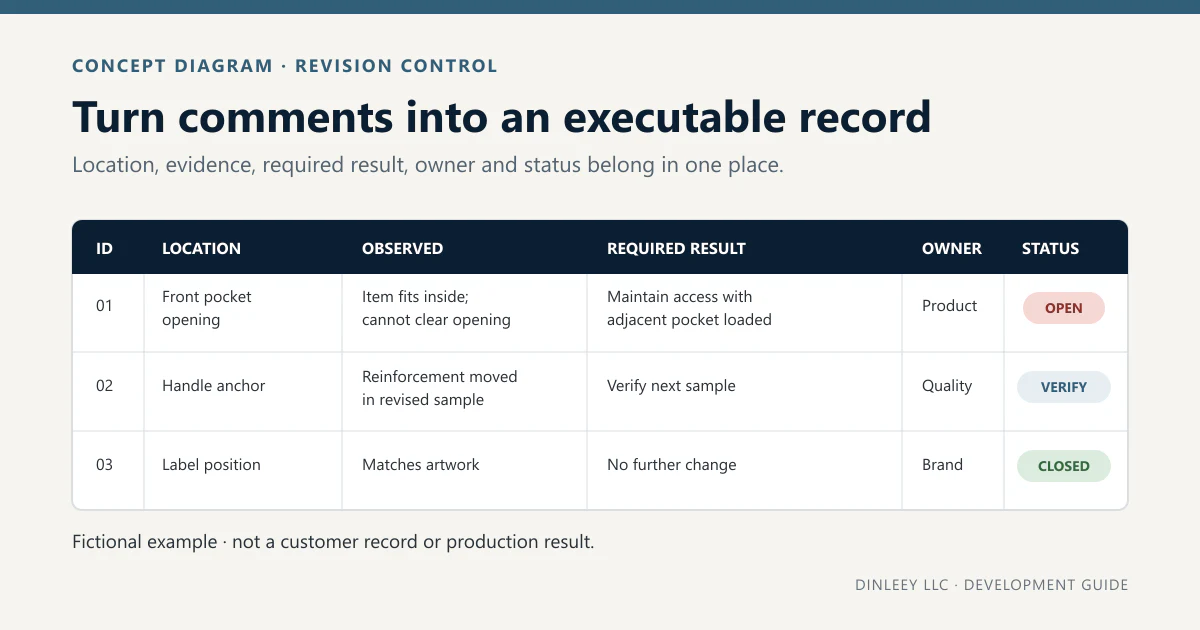
Feedback such as “make it stronger” or “improve the shape” does not identify the location, desired result or verification method. Consolidate comments into one controlled record.
| ID | Location | Evidence | Current condition | Required change or acceptance condition | Priority | Owner | Status |
|---|---|---|---|---|---|---|---|
| 01 | Example: front pocket opening | Photo or annotated drawing reference | State only what was observed | Define the required result without inventing the construction solution unless it is already specified | Blocker / major / minor | Named role | Open / closed / verify next sample |
Revision notes should:
- Refer to a visible location or controlled drawing callout.
- Separate the observed condition from the requested result.
- Use dimensions or acceptance criteria where the project has defined them.
- Name the person or role responsible for closing the item.
- Check the next sample against both the current specification and the previous comment list.
9. End With a Controlled Approval Decision
Avoid an open-ended “looks good.” Use a defined outcome.
| Decision | Meaning | Required record |
|---|---|---|
| Approve for the defined next stage | Current evidence supports the named next step | Exact sample version, released stage and approval authority |
| Conditionally approve | The next step may proceed while listed non-blocking items remain open | Open-item list, owner, deadline or next verification point |
| Revise and resubmit | One or more issues prevent the intended release | Controlled revision record and next-sample scope |
| Reopen the brief | The sample exposes a mismatch in the requirement or product direction | Updated use case, priorities and approval criteria |
Use the approved sample with the current specification, approved materials and components, artwork, packaging direction and quality plan. It is a physical reference within that controlled set, not a replacement for it.
10. Buyer’s Sample-Approval Checklist
Before releasing the next stage, confirm that:
- Sample identity, round and specification revision are recorded.
- The sample’s purpose and required decision are defined.
- Intended contents and use conditions are documented.
- The product has been checked empty, loaded, carried or installed, and operated where relevant.
- Fit, capacity, access and user sequence meet the defined requirements.
- Structure and reinforcement have been reviewed along the intended load path.
- Materials and components match approved references, or substitutions are visibly listed as open.
- Critical dimensions use defined measurement methods.
- Workmanship, manufacturability and cosmetic observations are separated by priority.
- Artwork and labels match the current approved files.
- Outstanding testing and evidence needs are listed.
- Revision comments are controlled in one record.
- The decision, sample version and approval authority are recorded.
Frequently Asked Questions
Is a first prototype ready for bulk production?
The label is not enough. Readiness depends on sample purpose and whether production-representative materials, components, construction, artwork, measurements, validation needs and open decisions are confirmed. Do not release production merely because it is called a prototype or pre-production sample.
Does an approved sample replace a technical specification?
No. It is a physical reference for one documented product version. It should be used with the current specification, approved materials and components, artwork, packaging direction and quality plan.
What if the sample uses temporary materials or hardware?
List each substitution and which decisions it supports. Final color, feel, performance, cleaning behavior and supply status remain open until the intended component and required evidence are reviewed.
How should vehicle-organizer fit be approved?
Review the product in the stated installation environment and document its attachment, clearance, access and interaction with relevant surrounding movement. Make a make/model/year fitment claim only when that specific application has been verified and recorded.
How do overseas teams approve a bag sample from a China OEM factory?
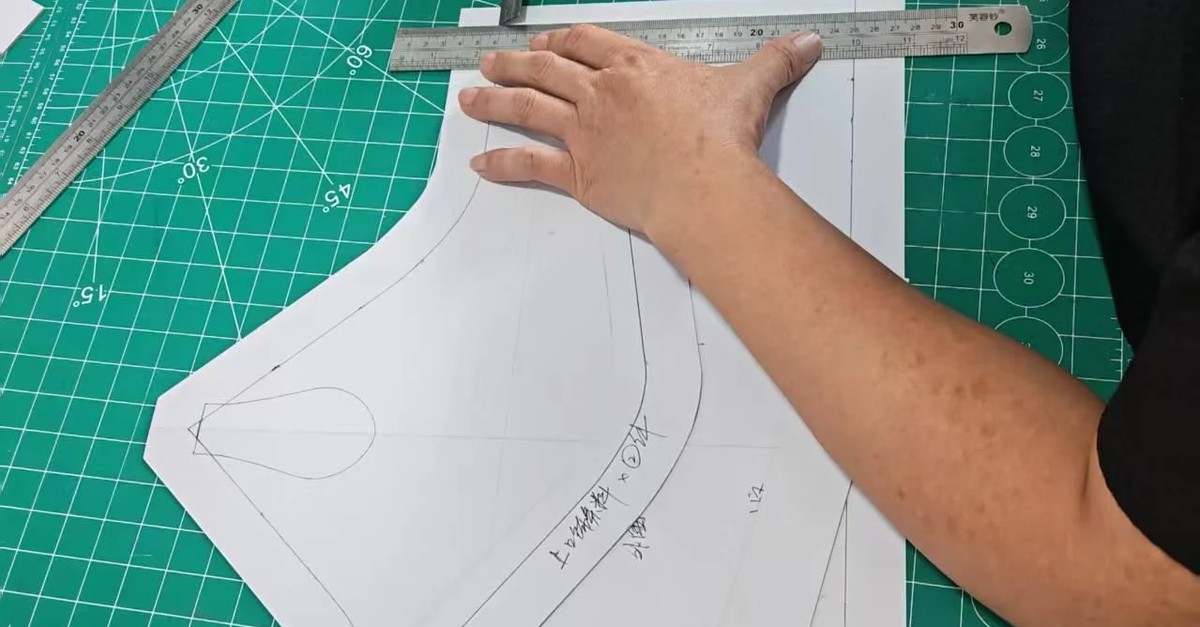
At DINLEEY, an OEM/ODM bag manufacturer in Guangzhou, China, approval runs in rounds: photos or video against your specification, then the physical sample, then one numbered comment list per round. Each revision is logged, and a dated, signed approved sample becomes the production reference.
Decision table and process photo: How do I approve a bag OEM sample from a China factory when my team is overseas?
Discuss the next sample stage with DINLEEY
If you are reviewing a prototype or production-representative sample, share the intended contents, installation or carrying context, current sample stage, specification status and open decisions. DINLEEY can assess whether the next useful step is requirement clarification, structural revision, another sample round, validation planning or production preparation.
Email: info@dinleey.com
Send a sketch or reference image, estimated quantity and target market.
We reply within 1 business day. Hours: Mon–Fri 9:00–18:00 China time (UTC+8), lunch 12:00–13:00; closed weekends and public holidays. WhatsApp +86 180 2808 9994